
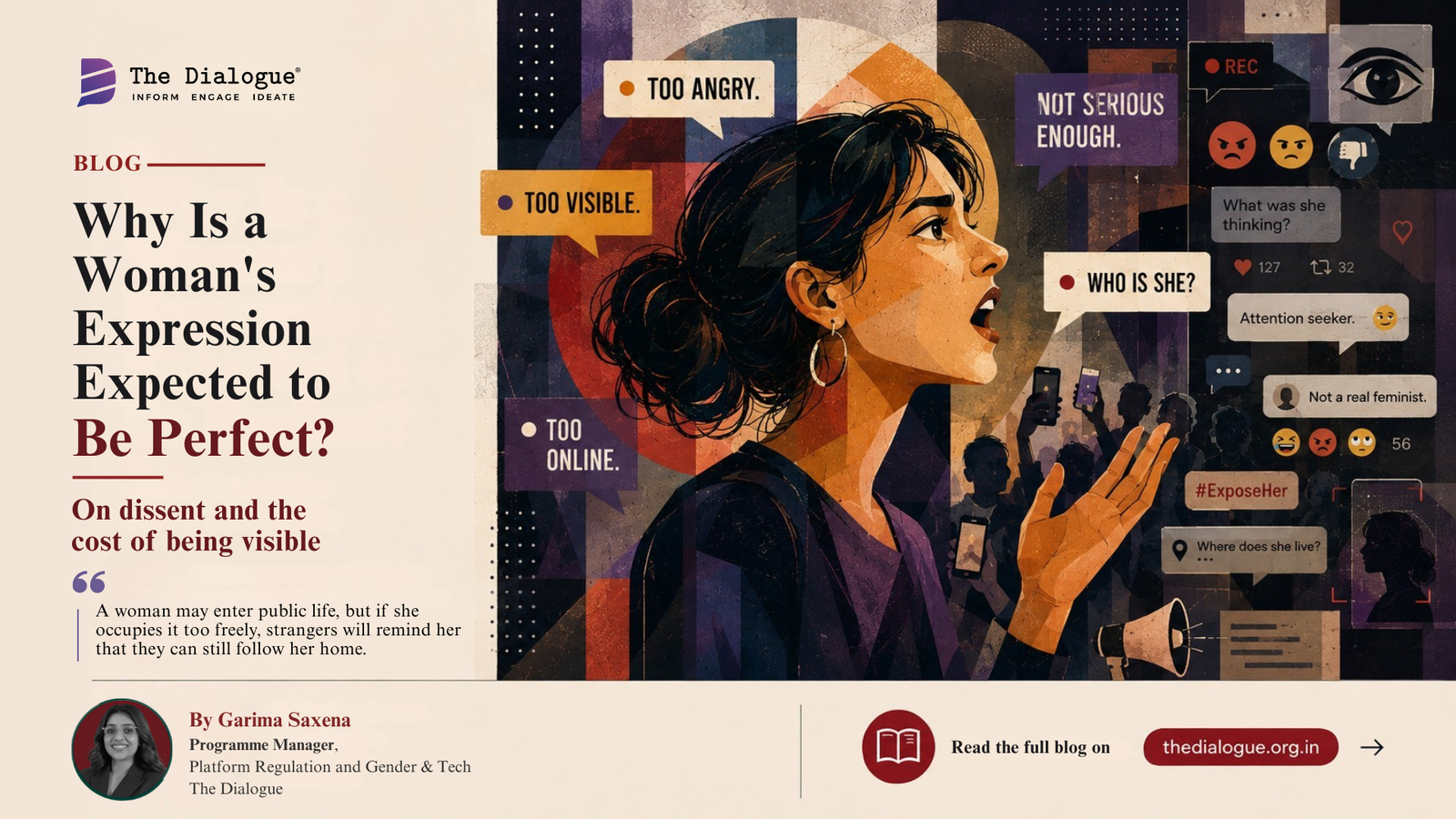
It angered me, but did it surprise me? It would be dishonest to pretend I hadn’t anticipated such an aftermath of the CJP protest. I knew that women who attended or supported the protest would be asked to explain themselves, not so much about what they were protesting for, but rather how they spoke, what they wore, what they posted on their socials, and whether they deserved to be heard. Their political participation and expression instantly became evidence that they had somehow failed the standards expected of them.
In such moments, one is reminded of the distinction between possessing a right and experiencing freedom. While freedom of expression, peaceful assembly and movement exist as constitutional rights, the ability to exercise them depends upon a far more complicated set of social conditions. Whether one can speak without being reduced to a spectacle, make mistakes without being turned into a cautionary tale, and return to an ordinary life after having expressed oneself publicly. For young women, those conditions are not evenly distributed, as their expression is often filtered through expectations of femininity, propriety and public morality. What is often demanded from us is not simply that we have something coherent to say, but that we say it but that we say it without disturbing anyone’s idea of what an acceptable woman should sound like.
The protest made this particularly apparent because it was recognisably Gen Z-led. Its vocabulary included memes, satire, fit checks and GRWM reels: the forms through which young people already communicate and interpret the world. None of this diminished the protest’s demands, but instead, it challenged the assumption that dissent becomes meaningful only when delivered through solemn faces and sanctioned language. Young women entered public life as they already existed–funny, aesthetic, digitally fluent and sometimes inconsistent, rather than performing an approved image of the political citizen.
Clips of women at the protest were taken from their accounts, cropped or altered, and shared with calls to identify, report or arrest them. Their phone numbers, addresses and workplaces were tracked down; relatives were contacted, and in some cases people arrived at their homes demanding apologies. One 15-year-old, after receiving rape, death and acid-attack threats, had to leave her home with her mother and younger brother and stopped attending school. Television coverage made matters worse by repeatedly airing short clips, visiting homes and workplaces, and bringing private messages into public circulation. The women ceased to be treated as people capable of making political claims and became objects from which evidence about their character could be extracted.
Such demand and expectations for perfect expression creates a standard that women cannot genuinely satisfy. More so, because it is less concerned with the quality of what is said and more with policing women who claim public authority. These terms often conveniently change according to whatever form expression takes. If a woman is angry, she is irrational; if she is funny, her humour proves that she is unserious; if she cares about her appearance, she is dismissed as shallow; and if she speaks imperfectly, the imperfection is used to discredit the politics itself. Whatever form she chooses can be recorded as the reason she is not a legitimate participant. The standard of “acceptable womanhood” is then enforced by collective policing. By identifying, exposing and condemning the supposedly improper woman, participants in an online pile-on can present themselves as defenders of morality rather than participants in harassment.
To me, the idea of loitering developed by Shilpa Phadke, Sameera Khan and Shilpa Ranade becomes particularly relevant here. Men can linger, gather and occupy public spaces without explaining where they are going, while women are more often expected to move between home and a recognisable destination with a respectable purpose. The difference lies not only in access but in the freedom to remain without justification. Political life is structured by a similar distinction. Women may be formally admitted into it, but their presence is expected to remain purposeful, respectable and disciplined. To loiter politically is to claim a place without having to present a perfect account of why one deserves to be there.
The women at the protest unsettled this arrangement by bringing anger and humour, demands and reels, argument and aesthetic expression into the same public moment. The digital witch hunt attempted to restore the boundary they had crossed, a [trial] to drive publicly visible women back into the private sphere by making continued visibility dangerous. The message was familiar, even if its form was new: a woman may enter public life, but if she occupies it too freely, strangers will remind her that they can still follow her home.
The warning was also directed at every woman watching to “make them understand” that political visibility may give strangers access to her family, workplace, photographs, and past. Some women will continue to speak, while others will hesitate, soften themselves or remain silent because the cost of participation has been made deliberately personal. Exclusion does not always require a formal prohibition when informal penalties are severe enough to make people withdraw on their own. The door may remain technically open while the consequences ensure that fewer women walk through it.
Perhaps this is where my anger lies and where the personal and the political become inseparable. Until women can be visible without becoming objects of scrutiny and imperfect without being dismissed from public life, what is offered as freedom will remain conditional permission, revocable the moment we become inconvenient.