
𝐖𝐡𝐚𝐭 𝐢𝐟 𝐈𝐧𝐝𝐢𝐚 𝐝𝐨𝐞𝐬𝐧’𝐭 𝐡𝐚𝐯𝐞 𝐭𝐨 𝐜𝐡𝐨𝐨𝐬𝐞?
Between innovation without sufficient oversight and control without sufficient openness, India can chart a third path.
Artificial intelligence (AI) has emerged as one of the defining arenas of global strategic competition, with some analysts describing it as the ‘central axis of 21st-century great power rivalry’.
Beyond its economic potential, AI is reshaping military capabilities, public administration, information ecosystems, and the balance of technological influence among states. As governments seek to harness AI’s transformative benefits while managing risks related to security, privacy, misinformation, and accountability, the question of how to govern AI has become as important as the question of how to develop it.
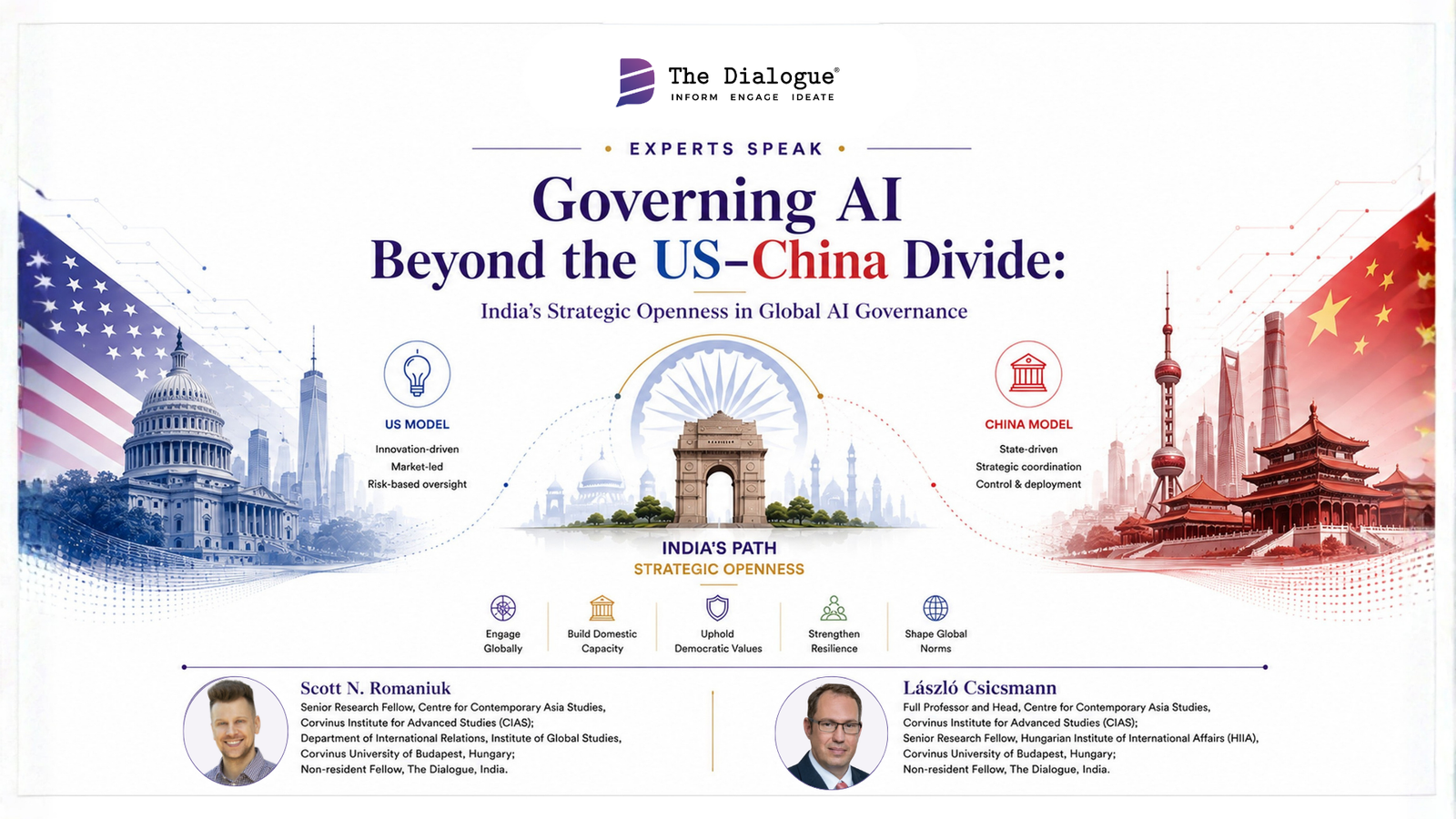
Global debates on AI governance are increasingly shaped by two broad approaches. The US has largely pursued an innovation-oriented model that emphasises private-sector leadership, market competition, voluntary standards, and risk-based oversight. This approach has helped sustain American leadership in frontier AI research and commercialisation, but it has also raised concerns about regulatory gaps, algorithmic harms, and the concentration of technological power among a small number of companies.
China, by contrast, has integrated AI development into a state-driven strategic framework. The Chinese approach combines industrial policy, government coordination, regulatory oversight, and large-scale deployment of AI in areas such as public administration, surveillance, and security. This model has played no small role in enabling rapid mobilisation of state resources and implementation. However, it has generated concerns regarding transparency, civil liberties, and the relationship between technological governance and state control.
These competing models increasingly influence global discussions on AI standards and regulation. For many countries, the challenge appears to be a choice between innovation without sufficient oversight and control without sufficient openness. India, however, has an opportunity to pursue a distinct approach: one based on strategic openness—maintaining engagement with global AI ecosystems while developing domestic capabilities, democratic safeguards, and regulatory capacity.
India’s AI Opportunities and Structural Constraints
With the world’s fourth-highest AI performance, India holds a distinctive position in the global AI landscape. As the world’s largest electoral democracy, the third largest digitalised country, and one of the fastest-growing digital economies, India has both the incentives and the scale to become a significant actor in AI development and governance. Its enabling conditions include a large pool of technical talent, a growing startup ecosystem, expanding digital infrastructure, and experience deploying technology solutions across diverse sectors.
India’s digital public infrastructure provides a foundation for large-scale technology adoption. AI applications in healthcare, agriculture, education, public service delivery, and language technologies demonstrate the potential of AI to address challenges in a country characterised by significant social and economic diversity. With the introduction of the Digital Public Infrastructure (DPI) initiative in September 2023 at the G20 Summit in New Delhi, India has aimed to become a global leader in the deployment of advanced technologies for governance. Aadhaar, the world’s largest biometric identification system, now covers nearly the entire population.
However, India’s AI ambitions also face major constraints. Access to advanced computing infrastructure remains limited compared with leading AI powers. Frontier AI research and foundational model development continue to be concentrated among a small number of global technology firms. Challenges related to data quality, availability, privacy protection, and institutional coordination continue to affect India’s ability to scale AI responsibly.
India’s semiconductor capabilities have seen progress through the iCET programme (US–India Initiative on Critical and Emerging Technology), which is based on deeper US–India cooperation. However, a major challenge to India’s AI ambitions is its continued reliance on China for semiconductor imports, leaving the country vulnerable due to the complexity of their bilateral relationship.
These realities shape India’s governance choices. A highly restrictive regulatory framework could slow innovation and increase dependence on foreign technology providers. In parallel, an overly permissive approach could deepen vulnerabilities related to misinformation, cybersecurity, bias, and misuse. India’s challenge is therefore not simply to regulate AI, but to build the institutional capacity required to govern it effectively.
Moving Beyond the US-China Binary
India’s AI strategy is likely to benefit from moving beyond the assumption that technological advancement requires choosing between competing governance models. Instead, a flexible approach combining innovation, accountability, and strategic resilience can better serve the country’s interests.
The US model offers important lessons regarding entrepreneurship, research ecosystems, and private-sector innovation. China’s experience demonstrates the ability of coordinated state action to accelerate technological deployment and infrastructure development. Yet neither model can be adopted wholesale in the Indian context.
India’s democratic institutions, development priorities, and strategic environment require an approach that preserves openness while addressing emerging risks. Strategic openness does not mean technological isolation or complete self-reliance. Instead, it means developing sufficient domestic capacity to reduce vulnerability while remaining connected to global innovation networks.
This approach would allow India to collaborate internationally while maintaining the ability to make independent decisions regarding critical technologies.
AI and National Security Considerations
AI’s dual-use nature places it directly within the national security domain. Advances in AI are transforming intelligence analysis, cyber operations, autonomous systems, military planning, and information warfare. At the same time, AI-enabled disinformation, synthetic media, and influence operations create new challenges for democratic resilience.
India also faces vulnerabilities arising from dependence on foreign AI models, cloud infrastructure, and advanced hardware. Global technology restrictions, export controls, and supply-chain disruptions could affect access to critical AI resources, while opaque algorithms and external dependencies may raise concerns around data security and strategic autonomy.
However, treating AI exclusively as a security issue would be counterproductive. Excessive securitisation could restrict civilian innovation and limit the social benefits that AI can deliver. India therefore requires a governance framework that recognises security risks while preserving openness and public trust.
Building an Indian Model of AI Governance
India’s AI governance framework can be understood through four guiding principles: proportionality, adaptability, sovereignty, and international engagement.
Consistent with India’s emerging policy direction, regulation reflects an effort to balance innovation with safety through a principle-based framework that encourages experimentation while introducing stronger safeguards where AI systems pose significant societal risks.
A risk-based regulatory framework provides an important foundation. Not all AI applications pose the same level of risk. Low-risk uses can be encouraged through innovation-friendly policies, while high-risk applications in areas such as public administration, healthcare, finance, security, and critical infrastructure require stronger oversight, including appropriate transparency, accountability, human oversight, and sector-specific regulation.
Strengthening institutional capacity is equally important. Effective AI governance requires coordination across ministries, regulators, technical experts, and industry stakeholders. Rather than relying on a single AI regulator, India’s governance framework can build on whole-of-government coordination while enabling sectoral regulators to oversee AI within their respective domains.
Building domestic AI capacity is another critical priority. This includes expanding access to computing resources, strengthening research institutions, improving datasets, encouraging open innovation, deepening public–private partnerships, and developing trusted data governance frameworks that support innovation while safeguarding privacy. Strategic autonomy in AI does not require India to replicate the entire AI supply chain domestically; rather, it requires the capability to participate meaningfully in global AI development.
India’s role in shaping international AI governance discussions also remains significant. Through multilateral forums, standards bodies, and partnerships with both advanced and developing economies, India can advocate for interoperable AI governance frameworks that emphasise accessibility, affordability, transparency, inclusion, and the interests of the Global South while remaining compatible with emerging international standards.
India as a Global AI Norm Shaper
India’s greatest opportunity may not lie in becoming the dominant producer of frontier AI models, but in emerging as an AI norm-setter by demonstrating how AI can be governed and deployed responsibly at scale.
The country’s experience managing technological adoption across a large, diverse, and developing society provides a perspective that differs from both US and Chinese approaches. India can contribute to global debates by advancing principles such as explainability, accountability, accessibility, and public trust.
Domestic credibility will be central to India’s ability to shape global AI governance. Transparent institutions, effective safeguards, and responsible deployment practices will determine whether India can translate ambition into influence.
A Path of Strategic Openness
AI governance is not a binary choice between innovation and regulation, or between the models promoted by Washington and Beijing. For India, the central challenge is to build a framework that enables technological growth while protecting democratic values, national interests, and public confidence.
A strategy of strategic openness offers India a path between dependence and isolation. By combining global engagement with domestic capacity-building, India can protect its autonomy, manage emerging risks, and contribute to the creation of an inclusive global AI order.
The opportunity to shape this future may narrow over time. The decisions India makes today will influence whether it remains primarily a consumer of global AI systems or also helps shape the rules that govern them.