The National Common Mobility Card (NCMC) initiative has recently recorded important developments across two states, signalling a renewed policy priority towards this intervention. One of these developments was the Maharashtra state transport minister announcing that the NCMC card shall be mandatory for all women and senior citizens from August 1, 2026 to avail concessions on Maharashtra State Road Transport Corporation (MSRTC) buses. In Karnataka, the Bengaluru Metropolitan Transport Corporation (BMTC) has almost finalised the process of installing buses with Electronic Ticketing Machines (ETM) compatible with the NCMC architecture, gradually replacing the existing dynamic QR system currently prevalent in BMTC buses.
These developments bring renewed attention to a larger question: nearly seven years after the NCMC was conceptualised, how close is India to delivering the frictionless, interoperable mobility experience it originally promised?
From “One Nation, One Card” to an evolving ecosystem
The foundation of the NCMC initiative, bearing the tagline “One Nation, One Card”, was conceptualised in 2019. The idea was to encourage last-mile connectivity, mobility and ease of payments by setting up an interoperable system of payments across various modes of public transport and points of sale (PoS), complementing futuristic smart cities. Recent data suggests that there are over 200 million NCMC-enabled cards in circulation, which is an impressive number; however, it does not represent the complete picture, since the current architecture has not evolved to support the entire spectrum of functionalities envisioned under the NCMC. This is the reason why we are seeing developments pertaining to the NCMC architecture even in 2026.
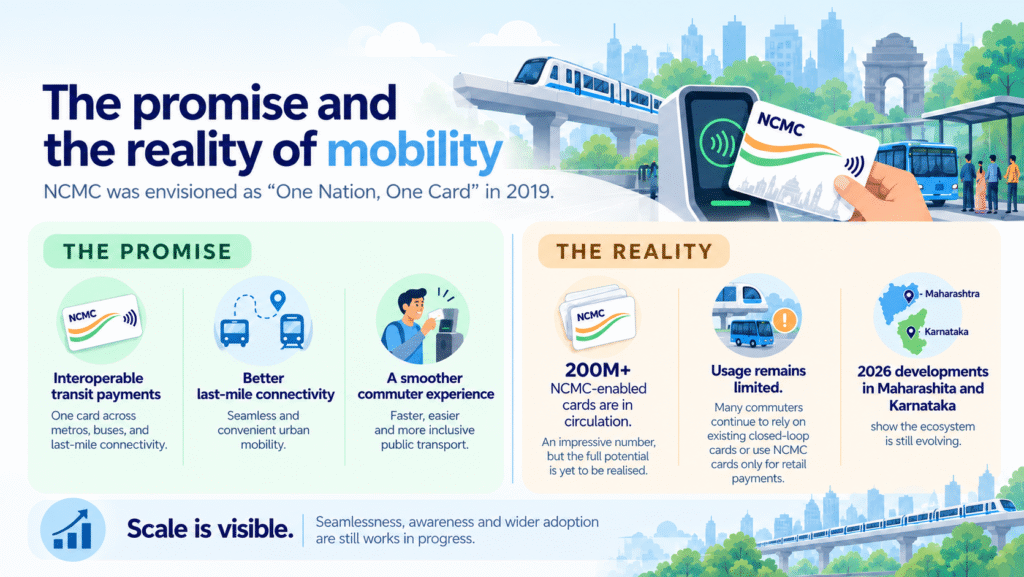
The scale of card issuance, in other words, tells only one part of the story. The more important test is whether commuters can actually use these cards as seamlessly as the original vision intended.
Where the friction begins
Although the Ministry of Housing and Urban Affairs (MoHUA) had mandated the issuance of NCMC-enabled cards by banks in 2023, consumers have struggled to gain the most from these cards. Limited consumer awareness and exclusion of non-RuPay card networks are consumer-side frictions that have limited the intended usage of NCMC cards, despite so many of them being in circulation currently. Let us delve deeper into these issues.
The NCMC was conceived as a hybrid EMV instrument that combines two balances on a single chip: a primary bank-linked account for online payments and an onboard stored-value transit wallet for offline tap-and-go fares. In principle, this architecture allows a single card to function simultaneously as a debit card and a transit token. In practice, however, the instrument has not displaced the legacy combination of a closed-loop transit card and a bank-issued debit card for the average urban commuter.
The transit functionality on these cards is not auto-enabled, and the customer must perform a service creation transaction before the card can be tapped at a fare gate. For a typical urban commuter who already holds a functional closed-loop transit card and a working debit card, the marginal benefit of consolidating two cards into one is dwarfed by the marginal cost of an additional counter visit or the friction of in-app activation. Furthermore, several customers are simply unaware this functionality exists.
This creates a paradox at the heart of the NCMC experience: a system designed to reduce friction can itself require additional steps before a commuter is able to use it.
One card, multiple user journeys
Since many cardholders possess cards that are issued by global networks, they are already excluded from the NCMC ecosystem unless they acquire a NCMC-enabled RuPay debit or credit card, or a Prepaid Payment Instrument for Mass Transit Systems (PPI-MTS) variant of the NCMC card. The latter is a minimum-KYC prepaid product capped at Rs. 3,000 following the RBI’s March 2024 relaxation, which is issued instantly at metro counters and is usable for fare payments from the moment of issuance, but offers no retail or e-commerce functionality at PoS.
These users obtain a working transit card and never engage with the wider payment dimensions that the NCMC was designed to deliver. Second, commuters who already hold incumbent closed-loop cards from local transit corporations such as the Delhi Metro Rail Corporation (DMRC) or the Bengaluru Metro Rail Corporation Limited (BMRCL) continue to use them, since these cards are already activated, already topped up, and already familiar. Third, holders of bank-issued NCMC debit cards typically use them only for retail and online transactions, in exactly the same manner as they would use a non-NCMC debit card, and never activate the offline transit wallet at all.
The result is not one unified commuter experience, but several parallel ones, each offering only part of what the NCMC ecosystem was intended to deliver.
In essence, for commuters wanting to acquire a fully functional NCMC-enabled card, they must acquire a RuPay-issued debit or credit card after performing full KYC and activating the offline wallet to unlock transit payments through a proprietary app or by visiting a metro counter. Due to the increased friction observed in this pathway, many commuters opt for the PPI-MTS variant of the NCMC card that is readily available at metro stations or quick-commerce applications.
This variant is essentially a rebranded closed-loop metro card with limited retail functionality subject to minimum-KYC. In cities such as Bengaluru and Delhi, this card only functions as a metro card, since the Automated Fare Collection (AFC) systems in their bus networks have not yet been fully unified to ensure compatibility with the NCMC architecture.
A design problem, not merely an adoption problem
This behavioural inertia, disincentivising users from acquiring fully functional NCMC cards, stems from shortcomings in the user-design architecture. Instead of creating a product and ecosystem that elevates the existing commuter experience, the policy directive focused on driving adoption by directing banks to issue NCMC cards by default and by intentionally discontinuing existing closed-loop transit cards, such as the One Card previously issued by the DMRC.
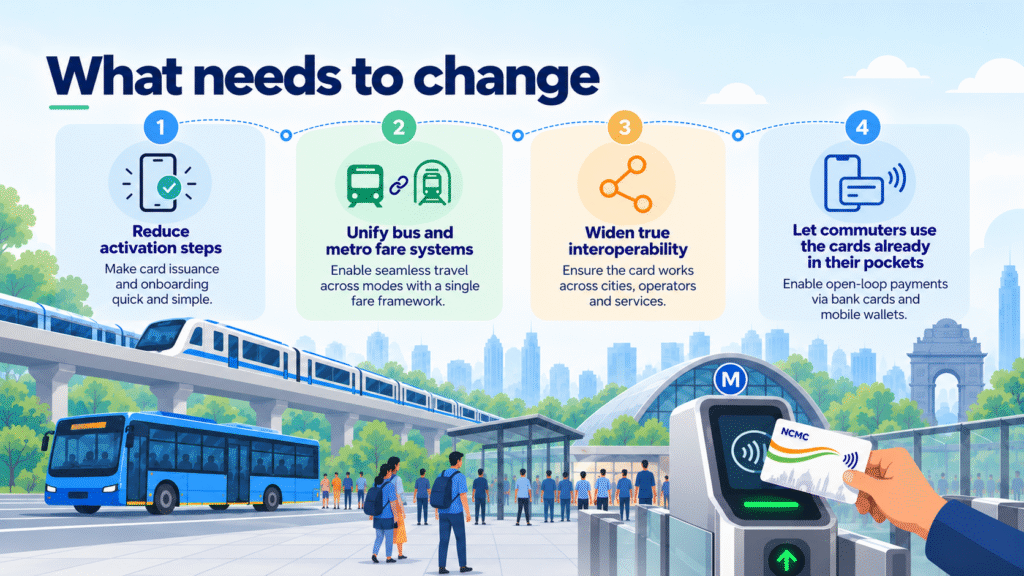
Instead of automatically nudging users toward the unified system through seamless defaults, the NCMC setup introduces multi-step activation hurdles. This added cognitive and physical friction inadvertently encourages commuters to stick with their existing, hassle-free legacy cards rather than actively opting into the new ecosystem.
This distinction matters. High circulation can demonstrate reach, but it does not necessarily demonstrate meaningful adoption. For a mobility system, success must ultimately be measured by what becomes easier for the commuter.
From card issuance to frictionless mobility
Therefore, although millions of commuters carry NCMC-enabled cards in their pockets, they still have not been able to fully utilise the functionality of the NCMC architecture due to the issues discussed above. Circulation numbers are bound to be impressive given the 2023 direction by the MoHUA to mandate the issuance of NCMC-enabled cards by banks, but the material impact of the NCMC policy on user ease and mobility is still up for debate.
In this context, it is argued that the NCMC must take inspiration from the Oyster ecosystem in London. This ecosystem allows standard contactless cards issued by global networks to double up as transit payment instruments. This truly interoperable EMV-compliant architecture is what the Indian transit payment ecosystem must transition towards in order to achieve the full scale of the NCMC vision.
In its current form, the aforementioned user-side frictions prevent commuters from fully utilising the benefits of an NCMC ecosystem. As cities continue to update their legacy AFC systems to accommodate NCMC features, it is important for users to fully benefit from the ecosystem once it is ready; for this, we should consider a system in which a user can utilise the entire spectrum of benefits arising from the NCMC ecosystem by just using the card that already sits in their pockets.
The promise of “One Nation, One Card” will ultimately be realised not when every commuter carries an NCMC-enabled card, but when the card itself becomes almost invisible to the journey: accepted across modes, simple to use, and requiring no additional effort from the person carrying it.