
Bengaluru helped build GTA VI. Who will back India’s next homegrown franchise?
Level One, Clause One: An Online Gaming Series
The highly anticipated Grand Theft Auto VI has finally been released, and around 1,600 developers from India contributed to it. This showcases the crucial role played by India in the development of one of the biggest games, and it would not have been possible without Rockstar Games’ Bengaluru-based studio. This goes back to 2019, when Rockstar Games acquired Dhruva Interactive in 2019 for USD 7.9 million. Dhruva was founded by Rajesh Rao in the 1990s, and since then, the studio has contributed to the development of over 150 games, including Halo 5 and Forza Motorsport 7. India has helped build some of the world’s biggest games. The question now is whether it can build the next big game of its own.
As GTA VI reaches users around the world, a lot has to be said about Indian talent, and more importantly about where it usually sits. While Indians have been part of building numerous world-famous games, the revenue and IP that come with these big games mostly belong to companies elsewhere. Therefore, it is important for India to move beyond co-development to actual ownership of the games they help build.
There is no shortage of interest from gaming studios in owning and launching their own games. In fact, the Game Developer Association of India’s (GDAI) GameDev Outlook 2026 (based on responses from 100+ Indian gaming studios) showcased that 82.7% of respondents list launching IP as a key goal. However, at the same time, 75% of respondents highlighted access to capital or publishing investment as a barrier to growth. Since most of these studios are very young and have small teams, it becomes especially important to ensure that the conditions in which they operate augment their growth. The concerns of Indian gaming studios can be resolved by focusing more on everyday bottlenecks, government support, and better flow of funding.
Decades of Building
Indian game studios have attracted interest from global game franchises for many years. For instance, Moonfrog Labs was acquired by Stillfront in 2021 for USD 90 million, and PlaySimple was acquired by Modern Times Group for approximately USD 360 million in the same year. As is evident, therefore, many studios from India have gained international recognition in the past couple of decades, but at the same time, there has not yet been an Indian-owned gaming franchise that has achieved comparable global recognition.
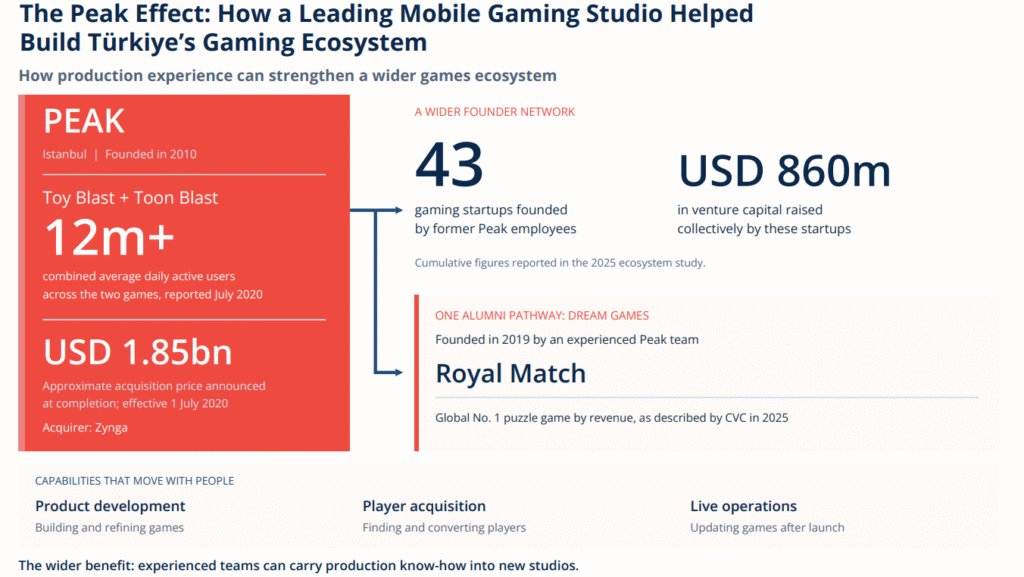
This naturally raises an interesting question: why is it important for Indian companies to own successful games? The answer: The Peak Effect, illustrated in the GDAI GameDev Outlook 2026, for which The Dialogue was the knowledge partner, explains this.
Source: GDAI GameDev Outlook 2026
Turkey’s Peak Games (a leading video game company) achieved initial success through its game titled “Toy Blast”, which helped put Turkey on the global gaming map. Peak was later acquired by Zynga in 2020 for about USD 1.85 billion. Former Peak employees then went on to establish 43 gaming startups that raised USD 860 million between them. This has happened in India too; former employees of Zynga India have helped found Moonfrog, PlaySimple, and Bombay Play. However, owning a globally recognised IP remains an unrealised ambition. By providing services, these game studios gain production experience; but owning games provides a lifetime of experience in developing and running them.
Strong Numbers, New Policy Push
For a long time, policy debate in this space mainly revolved around real-money gaming, but the Promotion and Regulation of Online Gaming Act, 2025 (PROG Act) changed this. By prohibiting online money games and naming e-sports and online social games as areas to be promoted, it gave the Centre and the states a clearer view of the gaming industry. Several government support measures have emerged recently, indicating a shift in the government’s approach towards supporting the sector:
- Many states now have dedicated AVGC-XR policies in place (and many are catching up in this race);
- The Ministry of Information and Broadcasting (MIB) launched the World Audio Visual & Entertainment Summit (WAVES) initiative in 2025, along with the proposed addition of seven WaveX Incubation Centres for AVGC-XR startups; WAVES Bazaar, a marketplace to connect creators with buyers, was also launched; and
- In the 2026-27 Union Budget, INR 250 crore was allocated to create AVGC Content Creators Labs within 15,000 schools and 500 colleges (led by IICT Mumbai).
Hence, progress is being made towards supporting India’s gaming industry, and credit must be given where credit is due.
However, it is also important to note that most of the initiatives above are aimed at talent and visibility. Three in four studios in the GDAI survey highlighted that capital and publishing investment were the main barriers to growth. Therefore, supporting developer training may not have much impact if studios struggle to raise funds, get paid on time, or access banking services without operational hurdles.
Where Studios Actually Get Stuck
Making an original game has a long gestation period. Teams have to be paid for at least a couple of years to build a demo that is playable, yet investors and publishers hardly commit to putting their money into these games before a demo is ready. Even after a playable demo is created, the developer/ studio needs financial support for production and monetisation. Once these issues are resolved, they reach the stage of negotiating rights. Therefore, an original IP offers monetary returns only after launch (if it reaches that stage). Co-development, however, is easier as it provides payments every month or per project. The gap, therefore, is that Indian studios need more early-stage capital to support development.
However, the flow of capital has also taken a hit. Since the PROG Act prohibits intermediaries from facilitating payments related to online money games, the banking process for studios has become more difficult and complex. The Promotion and Regulation of Online Gaming Rules, 2026 (PROG Rules), provide for verification of a game’s determination or registration status in accordance with applicable regulatory directions. While this makes sense as a safeguard, some banks are now hesitant to support any games.
Game developers consulted for the GDAI report described banks being reluctant to open accounts for premium game studios (offering online social games), and some insisted on gaming licences/permissions (which are voluntary for all online social games under the PROG Act and applicable Rules). Therefore, for the government, it is pertinent to note that a law meant to prevent online money games should not end up hindering the growth of new studios working on online social games.
Additionally, funds that do arrive can take time to reach studios. The GDAI report records a case in which foreign investment stayed unavailable for about six weeks over an address discrepancy, and others highlighted that GST refunds took at least three to four months.
Now, when we put these investment and funding-related hurdles in the context of the game development cycle, it becomes a concern. Timely investment is critical to the completion of a game, especially if it’s being developed by a small team. Therefore, these operational challenges make it difficult for a studio to ensure continuity of business operations and deliver on their projects.
The challenge, therefore, is not simply to encourage more studios to develop original games, but to ensure they have the means to bring those games to market.
What should we do to support the game development ecosystem?
Amongst the many challenges faced by game developers (which are dealt with in detail in the GDAI GameDev Outlook), the following solutions require immediate attention:
- Monetary support at the demo stage: Similar to other countries, the Indian government can focus on providing upfront grants to developers and studios building original games and IPs. Support at the demo stage can help grant recipients develop a playable demo to present to publishers and venture capitalists.
- Assistance in securing funds: Industry associations like GDAI and incubators like WaveX are already working towards this, but additional support should come from the government. Furthermore, new studios can be matched with experienced studios to help them navigate this stage (including negotiations over game development funding, marketing commitments, and rights).
- Banks to have a clearer understanding of the gaming ecosystem: A joint effort by the RBI and the Online Gaming Authority of India (OGAI) can assist banks in understanding the gaming ecosystem and what is categorised as an online money game. This joint effort by the two regulators can result in fewer operational hurdles within the banking ecosystem.
With the launch of GTA VI, we have now seen years of effort result in recognition. Efforts should be made towards ensuring that when a game developer or studio in a remote city in India has an idea of its own, it should have a fair chance to fund the game, find its audience, and forge a global reputation in its name.