A peculiar vocabulary has come to shape India’s Artificial Intelligence (AI) ambitions. At the AI Impact Summit organised by the Indian Government this year, one word recurred across multiple sessions during the five-day event: sovereign.
In its most basic sense, sovereignty conveys autonomy. In the context of AI, it signals a country’s capacity to build and control the systems on which economic and political life increasingly depends. This essay uses the term in a stricter sense, asking whether India owns, controls and can independently sustain the substrate on which its AI ambitions rest.
To understand the current landscape, it is useful to turn to the thesis of technofeudalism, introduced by economist Yanis Varoufakis in Technofeudalism: What Killed Capitalism (2023). His argument draws on the Marxian distinction between profit and rent. Profit is generated through ownership of the means of production and the exploitation of labour. Rent, by contrast, arises from control over a scarce asset that others must access in order to produce. The owner need not create something new; they can simply control access and collect a toll.
Varoufakis applies this distinction to cloud platforms, arguing that firms controlling the digital substrate increasingly collect rent on access rather than profit solely from production. He describes these structures as feudal because power is exercised through digital fiefdoms that, in his account, displace two features central to capitalism: markets and profits.
The thesis is contested. Critics argue that what Varoufakis describes is not the death of capitalism, but its mutation into a more concentrated and rent-heavy form. Markets continue to exist, and the technology companies at the centre of his argument remain embedded in conventional industrial production rather than functioning merely as rent collectors.
For the purposes of this essay, however, the most useful element of the technofeudal thesis is simpler: access without ownership.
That relationship, the author argues, is visible in India’s present AI position.
Traditionally, the serf worked on land that he did not own and surrendered a portion of his surplus to a lord who held title over it. In AI, a parallel can be observed. The contemporary substrate of production is computational capacity, and control over that substrate is highly concentrated.
Nvidia held an estimated 70–80% of the AI accelerator market by revenue in 2025, although this share is expected to soften through 2026 as competitors scale (CRN Asia / Hashrate Index, May 2026). The concentration is therefore significant, but not static. Importantly, some of the strongest competitive pressure comes not from rival chipmakers, but from the custom silicon being developed by American hyperscalers such as Google, Amazon and Microsoft.
India’s response to this structure has been substantial.
The IndiaAI Mission was approved with an outlay of ₹10,371.92 crore, approximately US$1.25 billion, over five years and across seven pillars. On compute specifically, the Government has stated its ambition of deploying tens of thousands of Graphics Processing Units (GPUs) at subsidised prices.
Available estimates placed deployment at more than 38,000 GPUs by March 2026, with ambitions to expand this further (Ministry of Electronics and Information Technology, Press Information Bureau, March 2026). These units have been offered to start-ups and academic institutions at approximately ₹115 to ₹150 per GPU per hour, rates that Government officials described as around 42% below prevailing market prices (Businessworld, February 2026).
Yet there remains a gap between ambition and expenditure.
In a reply to the Rajya Sabha during the 2026 Budget Session, the Ministry of Electronics and Information Technology (MeitY) disclosed that it had released only ₹21.79 crore in 2024–25, against revised estimates of ₹173 crore, and ₹379.15 crore in 2025–26, against revised estimates of ₹800 crore, as of February 2026. No funds had been released for the 2026–27 financial year at that point.
Total disbursement across the first two years was therefore just under ₹401 crore, less than 4% of the approved ₹10,371.92 crore outlay (MediaNama, April 2026).
The architecture of dependence may already exist, but the associated value transfer through subsidised compute remains limited for now. India’s AI ambitions continue to operate within the contours of an import-dependent design, although the rent that such a model might eventually channel abroad remains largely prospective.
One of the IndiaAI Mission’s most notable achievements is the migration of BHASHINI, India’s national multilingual platform, to indigenous cloud infrastructure. According to an Indian Government press release, the platform was transitioned to Yotta’s Government Community Cloud and Shakti Cloud with zero data loss across 3.5 billion files.
The release also reported performance gains of up to 40%, cost savings of 20–30%, and sustained uptime of 99.99% (The Tribune, February 2026). These figures should be interpreted cautiously, particularly because the underlying benchmarking methodology has not been publicly disclosed.
Yet the migration reveals a striking contradiction.
BHASHINI now operates on Yotta’s Shakti Cloud, but that infrastructure is powered by Nvidia H100 GPUs, while Yotta’s wider sovereign AI build is set to rely on Nvidia’s Blackwell Ultra hardware (Yotta Data Services, February 2026).
This raises a more fundamental question: does India’s AI sovereignty ultimately rest on American silicon?
The issue extends beyond hardware. There is no settled legal definition or standard for what constitutes “sovereign” infrastructure, allowing governments and companies considerable latitude in applying the term. Data held by a provider subject to a foreign jurisdiction may also remain accessible to that jurisdiction regardless of where the data is physically stored.
A 2025 legal opinion commissioned by the German Federal Ministry of the Interior similarly examined the reach of US jurisdiction over data stored abroad, including under the CLOUD Act, FISA Section 702 and the Stored Communications Act. Under the CLOUD Act, the central question can be whether a provider or its parent entity falls under US jurisdiction rather than simply where the data is physically stored.
The asymmetry is particularly relevant for India because the United States has entered into CLOUD Act executive agreements with the United Kingdom and Australia, but not with India. Indian agencies therefore continue to depend on the comparatively slower mutual legal assistance process (Eurojust, The CLOUD Act).
The technofeudal lens helps illuminate this contradiction.
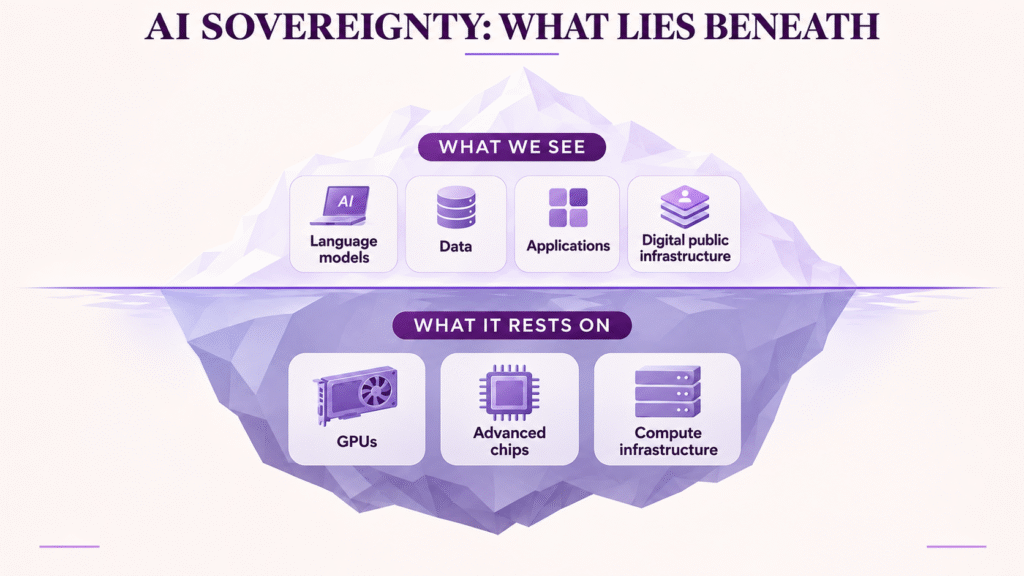
India has advanced rapidly across the layers it can build: language models, data, applications and digital infrastructure. However, the layer that increasingly constitutes the means of production itself, the compute substrate, remains substantially under foreign control.
The serf may improve the land, and may build well, even brilliantly, upon it. But the title to the land remains elsewhere. Improving the land can increase its value without changing its ownership.
What appears as autonomy, therefore, may in practice be advancement at the application layer resting on a borrowed substrate.
Dependence, however, is not confined to hardware. The same asymmetry can also be seen in where labour and value sit within the global AI supply chain.
A 2023 World Bank report highlighted that hundreds of millions of people worldwide engage in microwork, including image tagging, annotation and classification tasks used to train AI models, with many of these workers holding bachelor’s degrees. India stands out as one of the largest suppliers of this form of labour (World Bank, Working Without Borders: The Promise and Peril of Online Gig Work, 2023).
Microwork offers another point of entry into the global AI value chain, but it is often poorly paid and remains vulnerable to automation. This makes it a fragile foundation for long-term development.
Structurally, the risk is straightforward. Countries such as India may supply inexpensive human labour to train models while remaining dependent on foreign interfaces to access those same models.
It is the inference-economy problem in another form.
If the chips, foundational models and high-margin inference layers remain largely foreign or external, the domestic economy risks capturing lower-margin segments of the AI value chain while more durable rents accumulate upstream.
As noted at the outset, sovereignty in its literal sense implies freedom from dependence on an external will.
A polity that leases the substrate of its own intelligence production may secure the form of autonomy while conceding part of its substance. The rent described by Varoufakis can therefore appear in the contemporary AI economy not simply as extraction, but in the language of access, affordability and even partnership.
This can naturalise precisely the relationship that the language of sovereignty is intended to deny.
None of this means that India is permanently bound to a condition of dependence.
The IndiaAI Mission remains relatively early in its life, while the hardware layer itself is under intense competitive pressure. Domestic semiconductor fabrication, however, is a decade-long project, making it unlikely that India will close the gap with the United States or China in the near term.
Research on sovereign AI reaches a similar conclusion: full-stack technological sovereignty is structurally infeasible for almost any country, and greater attention should instead be directed towards managing interdependence through partnerships (Brookings Institution, Is AI Sovereignty Possible? Balancing Autonomy and Interdependence, February 2026; Tony Blair Institute for Global Change, Sovereignty in the Age of AI, January 2026).
If partnership is one of the forms through which access is now negotiated, India’s task is to negotiate its terms more effectively.
A foundation for this already exists on paper.
In 2025, India and the United States launched the Transforming the Relationship Utilizing Strategic Technology (TRUST) initiative, which promised a roadmap for US AI infrastructure in India (White House, United States-India Joint Leaders’ Statement, February 2025). The initiative, however, was still described by officials as under development in mid-2026, according to the subsequent reporting cited in the original essay.
In February 2026, the two countries also signed the AI Opportunity Partnership, setting out commitments around access to compute, although these commitments remain non-binding.
Events elsewhere demonstrate why the distinction between access and guaranteed access matters. In June 2026, the US Department of Commerce directed Anthropic to suspend access to its most advanced AI models for foreign nationals, before the order was lifted approximately two weeks later (Anthropic, June 12, 2026; Anthropic, June 30, 2026).
Against this backdrop, India’s core interest may lie less in pursuing absolute technological self-sufficiency and more in securing the terms of its interdependence.
This could include a binding compute agreement, guarantees of chip and model allocations over multiple years, and a CLOUD Act executive agreement establishing reciprocal legal access.
India could then concentrate more deliberately on the application layer, where digital public infrastructure and deployment at population scale remain among its strongest assets.
Such an arrangement would not transfer ownership of the underlying substrate. But it would, at the very least, put the terms of India’s access in writing and create grounds to contest their sudden withdrawal.
Perhaps that is the more useful test of AI sovereignty.
Not whether dependence can be eliminated altogether, but whether the terms of that dependence can be made predictable, reciprocal and resilient.