
On June 12, 2026, the US Department of Commerce barred Anthropic from sharing its two most capable AI models, Mythos 5 and Fable 5, with any foreign national, irrespective of whether they are living outside or inside the US. It’s an unprecedented move: for the first time, the US has applied export controls on AI model inference, rather than its earlier directives on chips and closed model weights.
The basis for this export control is believed to be research from Amazon engineers, which claims to jailbreak Fable 5 after a series of prompts to reveal information that can be used in cyberattacks.
Fable 5 is the publicly accessible, safeguarded version of Mythos 5, released just a couple of days ago. Mythos’s ability to detect vulnerabilities in just hours, generate automated hacks, and chain together minor vulnerabilities in ways that make detection by humans difficult prevented its worldwide release. For context, Microsoft’s cycle for fixing a vulnerability via a patch is monthly and happens on the second Tuesday of each month.
Agentic AI systems have reduced the time-to-exploit (TTE), the time between detecting a vulnerability and exploiting it, from years to mere hours.
Mozilla tested both Opus and Mythos for their ability to detect vulnerabilities in Firefox. Opus detected 22 bugs, while Mythos detected 271. Mythos also detected thousands of sensitive vulnerabilities in operating systems and web browsers during internal testing. Experts fear that the enhanced capability of Mythos and similar agentic AIs to detect vulnerabilities faster will exponentially increase the number of zero-day attacks. It is a cause for concern for countries already facing the threat of cyberwarfare from adversaries.
The exploitation of vulnerabilities in a nation’s critical infrastructure can now occur in hours, making agentic AI a national security concern. Therefore, it is important that countries developing their AI infrastructure on the US stack test their systems for vulnerabilities and patch them before cyberattacks occur. But now, with this export control in place, US allies and partners are effectively locked out and won’t have access to the tool required to develop countermeasures.
How the US Controls the Diffusion of AI
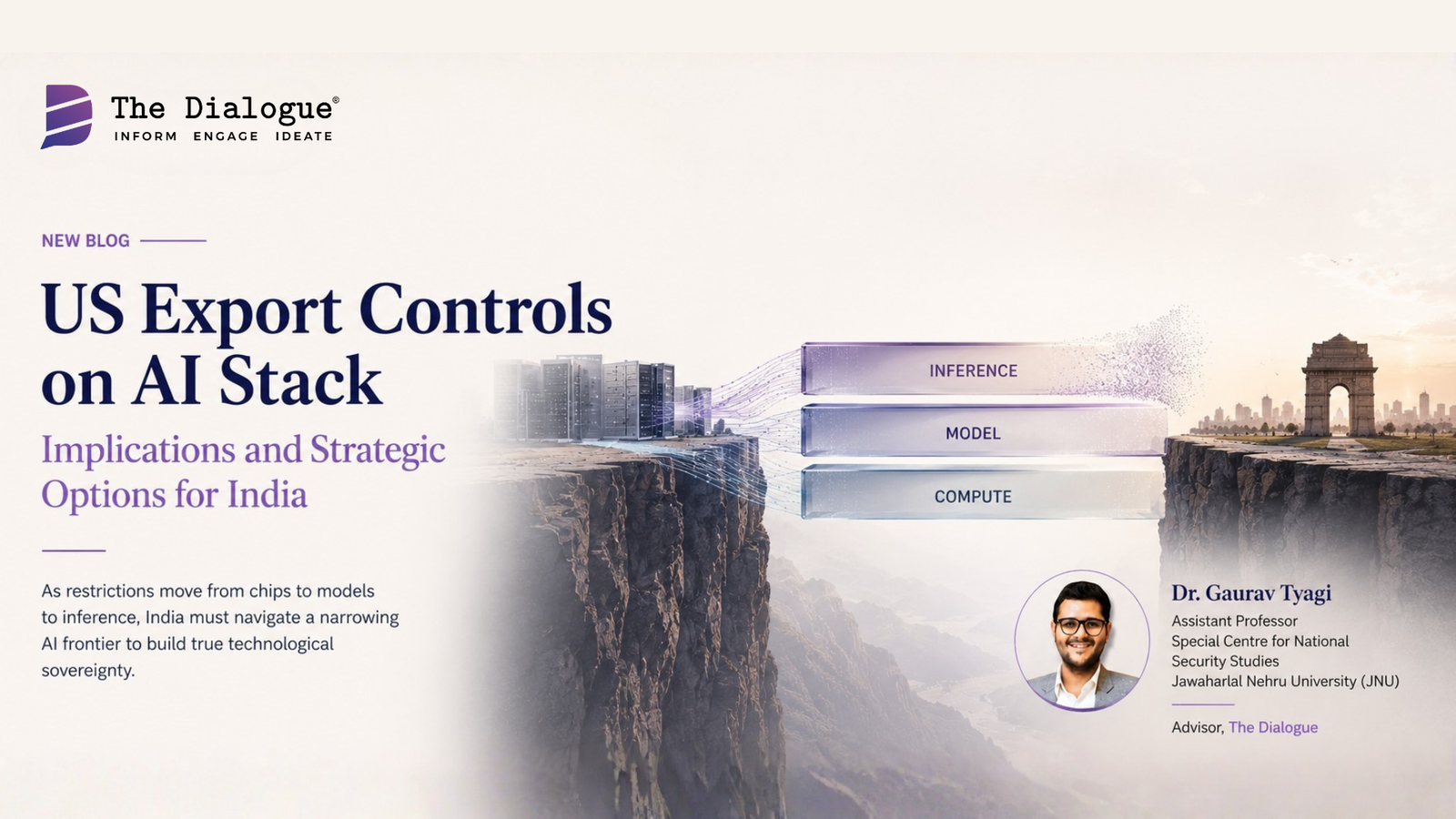
AI is not a single object that can simply be added to an export control list. Rather, it is a stack of three independent layers that have been subjected to export controls by the US at different points in time, including the latest directive on Mythos and Fable. These three layers are the compute layer, the model layer, and the inference layer.
Compute Layer
The compute layer includes chips as well as the hardware, tools, and machinery required to manufacture them. The manufacturing process of these high-end chips is concentrated in a handful of firms such as NVIDIA, AMD, ASML, and TSMC, making this layer comparatively easier to regulate.
The first major regulation came in October 2022, when the US Department of Commerce’s Bureau of Industry and Security (BIS) added certain high-performing integrated circuits to the Commerce Control List and tightened norms on the export of advanced machinery and equipment. The objective was to impair the People’s Republic of China’s capability to produce advanced-node semiconductors that can be used in advanced weapon systems, artificial intelligence, and advanced computing.
Further updates by BIS in 2023 and 2024 expanded the scope of restrictions by clamping down on modified “China-specific chips” and regulating the export of semiconductor design software.
Model Layer
There are two kinds of AI models: open-weight and closed-weight. Weights are parameters learned during training on vast amounts of data. The more parameters used in training, the more capable the model tends to be.
The first instance of regulating the export of AI model weights came through the Biden administration’s Framework for Artificial Intelligence Diffusion in January 2025. The framework introduced a tiered global system for regulating exports of advanced chips and imposed restrictions on certain frontier closed-weight models.
The incoming Trump administration subsequently rescinded the Diffusion Framework and opted instead for a bilateral licensing mechanism, including in relation to China. In December 2025, the administration allowed the export of H200 chips to China, roughly 75,000 units each to ten Chinese firms.
Inference Layer
The June 12 directive by the US Department of Commerce, citing national security concerns, denied access to Mythos 5 and Fable 5 for any non-American. This marked the first time the US government imposed export restrictions on a deployed model’s inference capability.
Over a period of three years, the focus of US export controls shifted from compute to inference. The compute layer remains subject to licensing arrangements, whereas deployed agentic AI systems are now subject to blanket restrictions based on nationality. The resulting paradox is that the US is simultaneously loosening restrictions on certain advanced chips while tightening restrictions on access to frontier AI systems.
India: Quest for a Sovereign AI Stack
We are in an era of great-power competition, wherein experts argue that the US seeks a unipolar world and multipolar Asia, China seeks a multipolar world and unipolar Asia, and India aspires to multipolarity in both.
Within this geopolitical framework, India must assess its AI stack across all three layers and devise a path to AI sovereignty.
Compute Layer
As part of the IndiaAI Mission, India has imported around 38,000 high-end chips from US firms. While this is a necessary near-term requirement, India must simultaneously build indigenous capabilities.
Strategic partnerships across the semiconductor value chain will be critical. The recent partnership between ASML and Tata Electronics for the Dholera fabrication facility represents an important milestone in India’s semiconductor ambitions.
Similarly, India’s commitment of approximately $18 billion across ten semiconductor projects is a welcome step, although a meaningful share of this investment should be directed toward research and development to build long-term technological self-reliance.
Model Layer
India requires sovereign open-weight foundational models.
Param-2, developed by the BharatGen consortium led by IIT Bombay and Sarvam-105B (Indus), built by Sarvam AI under the IndiaAI Mission represent significant milestones in India’s sovereign AI journey.
Inference Layer
India must build inference infrastructure, including servers, APIs, and interfaces capable of deploying sovereign open-weight models at national scale. This infrastructure should cater both to public-facing applications and to air-gapped environments used in critical infrastructure.
In these uncertain times, pragmatic diplomacy aimed at securing a formal AI-access arrangement with the United States, combined with astute commercial strategies to ensure continued access to advanced chips, will be essential for India’s sovereign AI ambitions. Sovereign AI is not a luxury. It is a strategic necessity that India must continue to pursue.