

Digital Public Infrastructure (DPI) has become one of the most significant outcomes of India’s digital transformation and an increasingly important element of its international engagement.
Originally developed to improve public service delivery, systems such as Aadhaar, the Unified Payments Interface (UPI), and consent-based data-sharing frameworks have evolved into interoperable digital systems that support financial inclusion, digital identity, and innovation at unprecedented scale. As more countries seek affordable and adaptable pathways to digitalisation, India’s DPI model has attracted growing global interest. According to the IMF, UPI has emerged as the world’s largest real-time payments (RTP) system by transaction volume.
This shift is emblematic of a broader geopolitical reorientation. Once viewed as a foundation for economic activity, digital infrastructure is now a critical arena of geopolitical competition, defining standards, governance frameworks, connectivity, and influence. Competing models, whether market-led systems dominated by private technology firms or state-centric approaches built around government control, are increasingly defining how countries pursue digital development and strategic partnerships.
India’s DPI model presents a distinct alternative. By combining publicly governed digital infrastructure with private-sector innovation and open, interoperable architecture, it provides a framework that differs from both Western platform ecosystems and China’s state-led model.
Its international expansion is not without tensions. Expanding DPI internationally brings into focus issues of cybersecurity, data governance, institutional capacity, and political trust. As digital infrastructure becomes an increasingly important instrument of statecraft, India’s ability to translate its domestic success into lasting international influence will depend on how effectively it addresses these and emerging challenges.
Inside India’s DPI Model
India’s approach to DPI rests on three interrelated principles: public stewardship of core digital rails, private-sector innovation at the application layer, and interoperability by design. Unlike proprietary platforms dominated by single firms, DPI separates foundational infrastructure, such as digital identity, payments, and consent-based data sharing—from end-user services. This architecture allows competition, innovation, and scale to coexist.
The success of Aadhaar-enabled authentication and the rapid adoption of UPI demonstrate how DPI can reduce transaction costs, expand financial inclusion, and unlock new opportunities in digital payments, lending, insurance, e-commerce, and other digital services. Rather than being purely technological, digital public infrastructure embodies institutional choices that shape access, privacy protections, and mechanisms of accountability.
An important component of India’s DPI is the promotion of digital literacy, supported by initiatives such as the PMGDISHA scheme (Pradhan Mantri Gramin Digital Saksharta Abhiyan). The scheme addresses the needs of rural populations by providing a 20-hour training programme focused on mobile and internet usage, as well as digital payment systems. It enhances the inclusiveness and effectiveness of the DPI framework by extending its benefits to communities with limited prior experience in digital technologies.
India has already begun supporting DPI initiatives in countries across Asia, Africa, and the Middle East, demonstrating how digital infrastructure can become a practical instrument of development cooperation and strategic engagement.
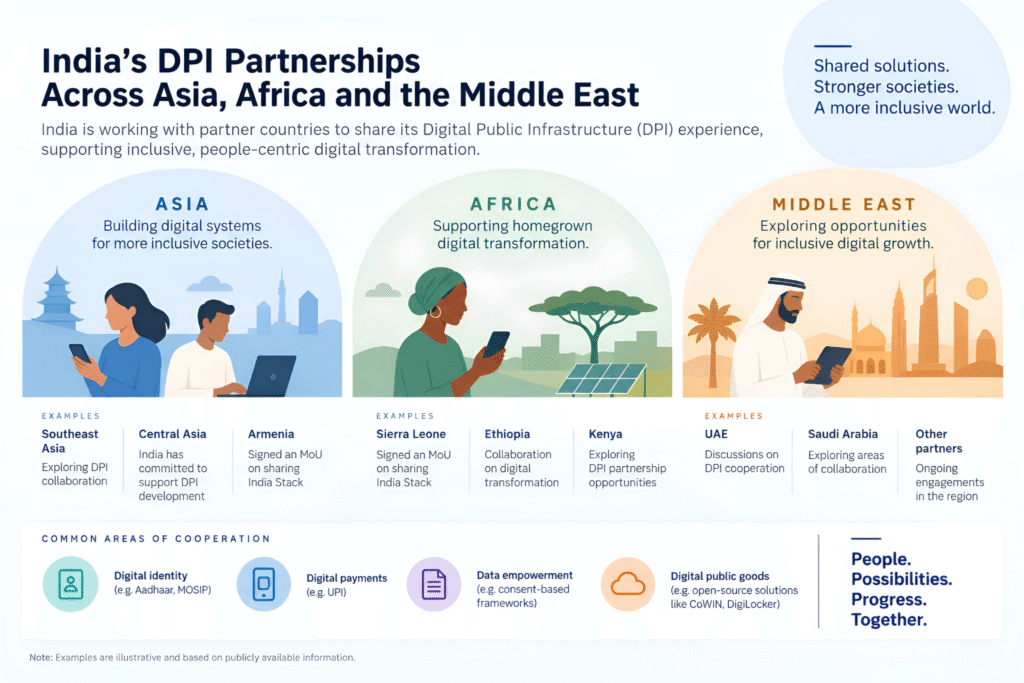
What distinguishes India’s DPI model globally is its ability to operate at population scale in a low- to middle-income context. This has attracted interest from countries seeking affordable, interoperable, and adaptable alternatives for building digital infrastructure and expanding financial and public services.
DPI in a Competitive Geopolitical Environment
International interest in DPI is closely tied to the intensifying global competition over digital infrastructure. China’s Digital Silk Road (DSR) has expanded rapidly, offering integrated technology stacks—often bundled with financing, to partner countries across Asia, Africa, and the Middle East, including Pakistan, Kenya, Ethiopia and Indonesia, as well as several Gulf states. While these systems promise speed and scale, they can create long-term dependencies, limit interoperability, and raise concerns about surveillance and sovereignty.
Western technology ecosystems, by contrast, are largely driven by private firms, with limited state-led infrastructure offerings. This can leave developing countries dependent on foreign platforms without meaningful control over data or governance.
India’s DPI model occupies a distinctive position. By emphasising open, modular infrastructure, it offers partner countries greater flexibility than vertically integrated digital ecosystems. This allows India to frame DPI as a developmental public good while simultaneously advancing strategic interests, strengthening its credibility as a partner in the Global South.
However, this positioning is not automatic. As DPI adoption expands, it will increasingly be viewed through a geopolitical lens, especially where digital infrastructure intersects with data sovereignty, financial systems, and governance capacity.
DPI as an Instrument of Statecraft
DPI provides India with new tools of digital diplomacy. By supporting other countries in building identity systems, payment rails, or data exchanges, India can deepen bilateral relationships while contributing to long-term institutional capacity. Unlike traditional development assistance, DPI partnerships can create long-term institutional linkages by embedding digital governance capabilities within partner states.
Multilateral initiatives to promote Digital Public Goods further amplify this influence. By working through international organisations and open-source communities, India can scale its model while reducing perceptions of unilateral dominance.
DPI also strengthens India’s voice in global governance debates. As discussions around data governance, digital inclusion, and AI regulation intensify, India’s experience provides empirical grounding for policy positions rooted in scale, affordability, and inclusion.
Constraints and Risks
Despite its promise, DPI is not a frictionless export. Institutional capacity varies widely across countries, and replicating India’s experience requires more than technical deployment. Weak governance, political instability, or low public trust can undermine DPI effectiveness and expose India to reputational risk.
Cybersecurity is another critical concern. As DPI systems handle sensitive personal and financial data, breaches or misuse in partner countries could undermine confidence in the model itself. This raises questions about responsibility, liability, and long-term support.
Domestically, India also faces the challenge of reconciling DPI’s global promotion with ongoing debates around privacy, data protection, and surveillance. Tensions between domestic governance practices and international messaging could weaken India’s normative credibility.
Finally, scaling DPI diplomacy requires coordination. At present, responsibilities are dispersed across ministries, regulators, and quasi-public entities, creating risks of fragmentation and duplication.
Policy Pathways for DPI Diplomacy
Realising DPI’s geopolitical potential will depend on advancing a set of core policy priorities. A key step is institutionalising DPI diplomacy through a dedicated coordination mechanism that aligns foreign policy, technology policy, and development cooperation. This would reduce ad hoc engagement and ensure greater strategic coherence.
Equally important is adopting a partnership-first approach centred on co-development with recipient countries. Tailoring DPI to local legal, cultural, and political contexts can strengthen ownership, legitimacy, and long-term resilience.
Building trust is essential to DPI’s long-term success. This requires investment in cybersecurity, data protection frameworks, and capacity-building for regulators and public servants. Ultimately, trust, not technology alone, determines the success of DPI partnerships.
Embedding DPI within multilateral frameworks can strengthen its global legitimacy. Positioning DPI as a global public good rather than a national export can help insulate it from geopolitical backlash while reinforcing India’s role as a bridge-builder.
From Infrastructure to Influence
Digital Public Infrastructure represents a significant shift in how technological influence is exercised. For India, DPI is more than a domestic success story, it is a strategic asset that aligns development goals with geopolitical relevance.
If managed carefully, DPI can allow India to shape the digital futures of partner countries while reinforcing its own strategic autonomy. The challenge lies not in proving DPI’s value, but in governing its expansion responsibly in an increasingly contested digital world.